Ideas > Celebrities:
What the 2026 World Cup Teaches Growing Brands
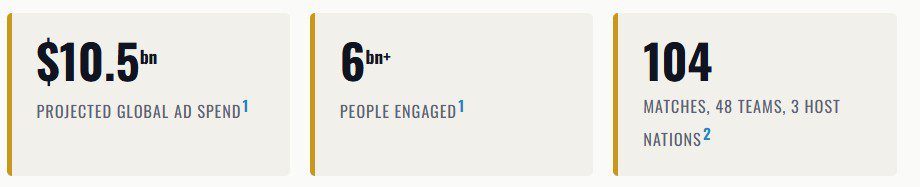
Every four years, the football World Cup turns into the single largest attention event on the planet — and one of the most expensive. This year’s tournament is projected to attract around $10.5 billion in global advertising spend and engage more than six billion people, which is why broadcaster ITV described it as a “six-week Super Bowl for advertising brands.” This is World Cup 2026 brand lessons.
For any brand — not just the fast-moving consumer goods (FMCG) giants — that is a rare and enormous opportunity. But watch this year’s campaigns closely and a costly pattern emerges. Most brands are buying attention brilliantly and building memory poorly. The lesson underneath it applies just as much to a growing SaaS company or D2C label as it does to a soft-drink multinational.
World Cup 2026 brand lessons: Lesson 1: The celebrity trap
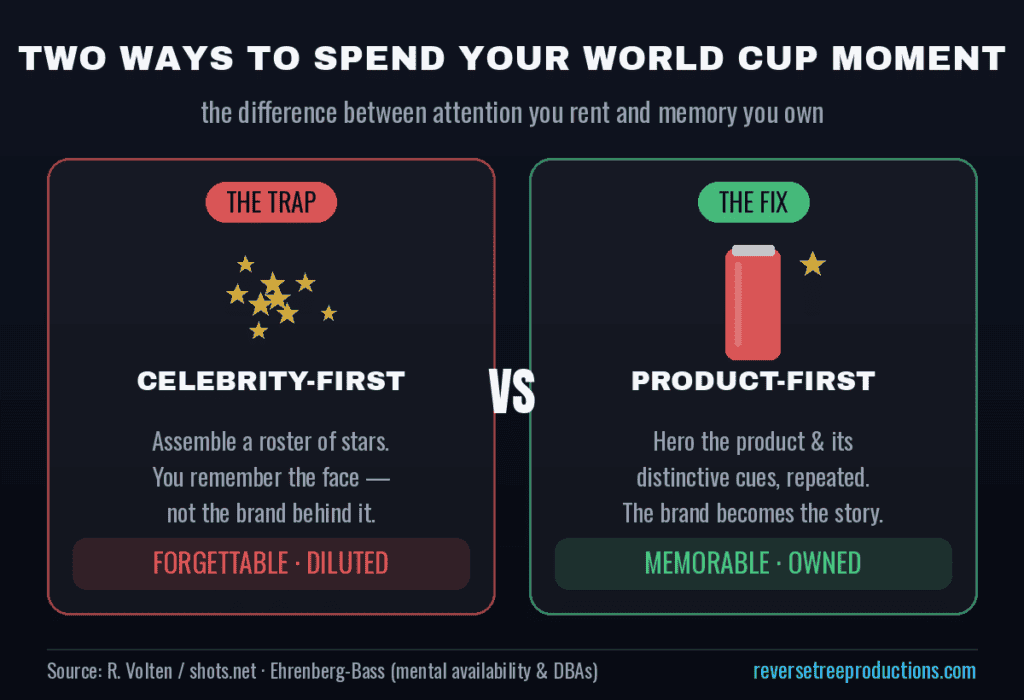
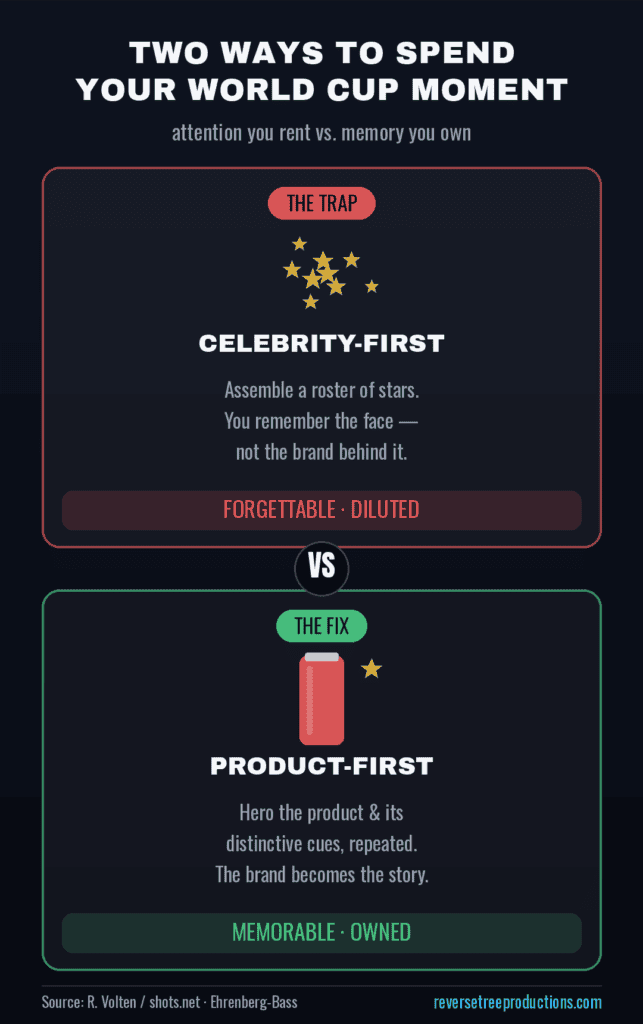
Faced with the noisiest advertising window of the decade, brand after brand has reached for the same tool to cut through: fame. Lay’s “Most Epic Watch Party,” for example, assembles a cast including Lionel Messi, Alexia Putellas, Thierry Henry, Steve Carell and — almost inevitably — David Beckham. Impressive roster. Forgettable brand.
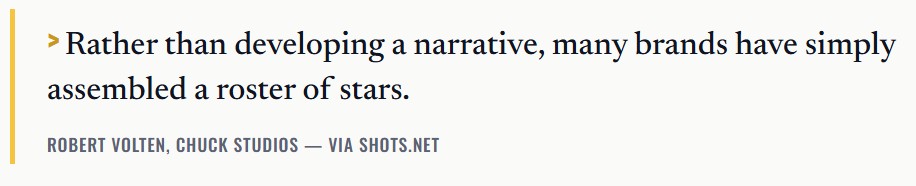
To be clear, there is nothing wrong with celebrity in advertising. Some of the greatest ads ever made ran on star power — Betty White in Snickers’ “You’re Not You When You’re Hungry,” or Michael Jackson for Pepsi. The problem, as Chuck Studios’ Robert Volten argues in the piece that prompted this article, is that most World Cup ads aren’t using celebrities to amplify a brand message — they’re using them as the message. Rather than developing a narrative, many have simply assembled a roster of stars, producing a sea of sameness in which you remember the face and forget the product.
There is a sharper problem still. A famous face can — and does — appear for everyone. This World Cup alone, David Beckham has fronted work for Home Depot, Adidas, Pepsi and Lay’s, making it nearly impossible to remember which product he was actually selling. Your product has no such disloyalty: unlike a celebrity, it can’t turn up in a competitor’s campaign next week. That is exactly why it deserves to be the hero.
What actually builds a brand: mental availability
The thing brands are really competing for isn’t a moment of attention — it’s mental availability: being the brand a person thinks of at the point of purchase. Decades of research from the Ehrenberg-Bass Institute show mental availability isn’t won through fleeting cameos; it accumulates through consistency — distinctive cues repeated over time.
These Distinctive Brand Assets are what make a brand instantly recognisable regardless of context — the lime wedge that immediately says Corona, the cheese-dust fingertips that are unmistakably Cheetos.5 A moment like the World Cup is a rare chance to deposit into that memory bank at scale. Brands that prioritise celebrities over product and narrative spend a fortune without ever making the deposit.
Even a celebrity can become a brand asset — but only through consistency. George Clooney’s two-decade partnership with Nespresso has seen him evolve from ambassador into a genuine, ownable brand cue. The mistake most brands make is treating a famous face as a one-off, which is worse still when that same face has already lent itself to rivals.
World Cup 2026 brand lessons: Lesson 2: Hero the product
The fix is refreshingly simple: start with the idea. Decide what you’re trying to communicate and why — then, and only then, choose the tactics that bring it to life, whether that’s a jingle, an ambassador, or a piece of music. What should never be relegated to an afterthought is your product and what makes it distinctive.
Coca-Cola’s “Uncanned Emotions” film shows how. It puts the attention firmly on the product codes that make Coke what it is — the condensation on the can, the twist of the cap, the unmistakable colour of the liquid — with a narrative built around the product itself in the hands of every fan. It features star football commentators, but it isn’t reliant on them; the product does the heavy lifting and becomes the protagonist, not a prop.
None of this means abandoning emotion — quite the opposite. The World Cup is the most emotionally charged month on the global calendar, and analysis of the IPA Databank by Les Binet and Peter Field found that emotionally-led campaigns are around twice as likely to deliver large profit gains as rational, feature-led ones.6 The winning move is to plug into that emotion and keep the product at the centre of it.
Why this matters for growing brands, not just FMCG
You may not have a Super Bowl budget or a global tournament to advertise around — but the principles scale down perfectly to a product launch, a category campaign, or a founder-led brand film. Three things to take from this year’s World Cup:
1. Idea before tactic. Work out the message and why it matters before you decide how to execute it. A borrowed trend or a familiar face is a tactic, not a strategy.
2. Make the product the hero. Show what it is, how it works, and the cues that make it unmistakably yours. Your product is the one asset a competitor can never borrow.
3. Consistency beats one-offs. Distinctive assets and mental availability are built by repeating the same cues across every video and campaign — not by a single expensive splash.
How Reverse Tree Productions Helps Brands Build Trust Through Video Content

At Reverse Tree Productions, we help businesses create video content designed not just to attract attention — but to build credibility.
We create:
- social media video ads
- founder-led storytelling videos
- customer testimonial videos
- product demo videos
- short-form social media content
- branded storytelling campaigns
- corporate videos
designed specifically for modern platforms like:
- YouTube
- short-form video ecosystems
Our approach focuses on:
- authentic storytelling
- strategic video communication
- audience psychology
- platform-native content
- long-term brand building
because in today’s digital world, audiences no longer trust advertisements alone.
They trust brands that communicate honestly and connect emotionally.
Explore our work at:
https://reversetreeproductions.com
Helpful Industry Resources & References
- Ad spend, audience & the “six-week Super Bowl” quote. Figures of ~$10.5 billion in global ad spend and 6 billion+ people engaged are pre-tournament projections attributed to ITV, as cited in the source article below. Volten, R., “Ideas > celebrities: What FMCG brands can learn from this year’s World Cup,” shots, 30 June 2026 — shots.net.
- Tournament format (48 teams, 104 matches, 3 host nations). FIFA, “FIFA World Cup 26” official tournament information — fifa.com.
- Core argument and campaign examples — the “roster of stars” critique; Lay’s “Most Epic Watch Party” cast; Snickers/Betty White and Pepsi/Michael Jackson; the David Beckham multi-brand point; George Clooney & Nespresso; Stella Artois “Celebration”; and Coca-Cola’s “Uncanned Emotions.” Volten, R. (Managing Partner, Chuck Studios), shots, 30 June 2026 — shots.net.
- Mental availability — the concept that brands grow by being easy to think of at the point of purchase, built through consistency. Sharp, B., How Brands Grow, Ehrenberg-Bass Institute / Oxford University Press — marketingscience.info.
- Emotional vs. rational campaign effectiveness — emotionally-led campaigns are roughly twice as likely to drive large profit/business effects. Binet, L. & Field, P., The Long and the Short of It and Marketing Effectiveness in the Digital Era, IPA (Institute of Practitioners in Advertising) — ipa.co.uk.
- Distinctive Brand Assets (DBAs) — the framework behind cues like the Corona lime and Cheetos dust. Romaniuk, J., Building Distinctive Brand Assets, Oxford University Press, 2018.

Having served hundreds of clients worldwide, Reverse Tree Productions stands as the first choice for corporate communication tools and video production solutions. Operating globally as an ace Corporate film maker, as well as printing and branding experts, we offer a wide range of service-based products and communication tools designed to help organizations strengthen their brand presence.
GET IN TOUCH
- Pocket 9, Sector 24, Rohini, Delhi, 110085
- +91 9999918466, +91 9999163155
- abhishek@reversetreeproductions.com
© 2025 ReverseTreeProductions. All rights reserved.